Dutch-German AOPA Fly-In highlights cross-border cooperation
A successful AOPA Fly-In at Stadtlohn-Vreden brought together pilots, organisations and aviation businesses from both sides of the Dutch-German border.
On 4 July, Flugplatz Stadtlohn-Vreden (EDLS) hosted a well-attended AOPA Fly-In that demonstrated both the diversity of General Aviation and the value of cooperation across national borders.
Located in Germany just a short distance from the Netherlands, Stadtlohn was a natural venue for the event. The airport has long-standing links with Dutch aviation, with an estimated 35 to 40 per cent of its users coming from the Netherlands. For many Dutch pilots, EDLS is effectively part of their regional GA network.
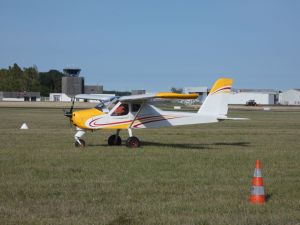
The Fly-In was organised by airport manager Rob Zeevalk together with AOPA Netherlands board member John van Asperen. Favourable summer weather brought visiting aircraft to the apron, while exhibitors, presentations and demonstrations attracted pilots and visitors throughout the day.
The event offered a broad cross-section of today’s GA community. Touring aircraft, light sport aircraft and training machines were joined by companies and specialists active in maintenance, avionics, insurance, training, simulation and digital services. Presentations addressed practical developments in cockpit technology, automation, safety, maintenance and the continuing digitalisation of aviation.
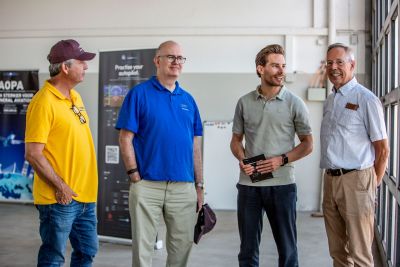
A central theme of the day was Dutch-German cooperation. AOPA Netherlands was strongly represented, while AOPA Germany also participated. AOPA Netherlands chairman Mark Rademaker met with AOPA Germany managing director Michael Erb, who travelled from Frankfurt together with treasurer Bülent Emekci. AOPA Germany board member Clemens Bollinger was also present.
Their participation reflected a wider European reality. Many of the major challenges facing General Aviation – including airspace access, regulation, airport infrastructure, fuel availability, rising costs and sustainability – increasingly extend beyond national borders. Close cooperation between national AOPA organisations therefore remains essential to effective advocacy for GA pilots and aircraft owners.
Stadtlohn itself illustrates the cross-border nature of European General Aviation. Although located in Germany, the airport has served Dutch pilots for decades. Its 1,240-metre paved runway accommodates a wide range of GA aircraft, and the airport records approximately 40,000 to 45,000 movements annually.
Beyond aircraft and presentations, the Fly-In was above all an opportunity for pilots, owners, instructors, engineers and aviation organisations to meet and exchange experience. There was also attention for increasing the visibility and participation of women in aviation.
The Stadtlohn Fly-In offered a practical reminder of what European General Aviation can achieve through cooperation. From the air, national borders are often barely visible. On the ground, shared interests in safety, access, innovation and the freedom to fly provide an equally strong basis for working together.
COMLOSS: Don’t be the reason
Loss of communication may begin with something as simple as a missed frequency change, an incorrectly selected radio frequency or the volume turned down too low. But in European airspace, the consequences can be serious.
EUROCONTROL is drawing renewed attention to COMLOSS — loss of communication between an aircraft and Air Traffic Control — with a clear message to pilots: #dontbethereason.
Since 11 September 2001, unexplained loss of radio contact has become not only a safety issue but also a security concern. Controllers cannot immediately know whether a silent aircraft is experiencing a technical or operational problem or whether something more serious is happening. According to EUROCONTROL campaign material, around 90% of aircraft interceptions in Europe in recent years have been attributed to COMLOSS situations.
Such interceptions are far from harmless. They disrupt the air traffic management system, consume scarce military resources and create additional safety and financial consequences for civil aviation, military authorities and the pilot in command.
A particular risk arises around Flight Information Region (FIR) boundaries. As EUROCONTROL’s campaign posters point out, COMLOSS often occurs near these boundaries, where pilots may be expecting — or may inadvertently miss — a frequency change. The message is simple: know when you are approaching an FIR boundary, anticipate the handover and, if you suspect you have crossed the boundary without checking in, ask ATC.
For pilots, prevention starts with disciplined radio procedures. Always read back assigned frequencies, use standard radiotelephony phraseology and cross-check the frequency after selection. Check radio settings and volume and treat an unusually long period of silence as abnormal rather than reassuring.
If you suspect that communication has been lost, carry out a radio check. EUROCONTROL also advises pilots to monitor 121.5 MHz continuously. If in doubt, call ATC on 121.5 and/or squawk 7600. Other appropriate frequencies may be tried, and nearby aircraft can be used as relay stations. In the event of actual radio communication failure, pilots should follow standard ICAO procedures.
The traditional priority remains: aviate, navigate, communicate. EUROCONTROL’s campaign adds a useful reminder for today’s increasingly busy and security-sensitive European airspace: communication is not an afterthought. A missed frequency change can escalate quickly from a minor cockpit error into a major operational and security event. Don’t be the reason
Italy: Growing concern over enforcement measures affecting GA
IAOPA Europe and AOPA Italy are increasingly concerned about customs and tax enforcement measures affecting General Aviation in Italy, particularly non-EU-registered aircraft.
Reports indicate that a growing number of Italian airports require advance customs notification for aircraft registered outside the EU, including US (N), Swiss (HB), Norwegian (LN) and San Marino (T7) aircraft. At some airports, notification may be required three to twelve hours before arrival — even for flights within Schengen or, in some cases, within Italy itself.
According to AOPA Italy, this is part of a wider trend involving increased customs inspections, tax investigations and administrative action. Particularly serious are reports of aircraft being fined or seized despite owners maintaining that the aircraft had legally entered the EU and that VAT obligations had been fulfilled.
In one case, a US-registered aircraft that had been legally based in Europe for many years was grounded after arriving in Italy because customs demanded recent import documentation. Legal representatives involved say that around thirty similar cases may now be known. AOPA Italy intends to collect further evidence from affected pilots, some of whom have faced substantial legal costs.
The legal basis for these measures is disputed. Complaints have been lodged with the European Commission, arguing that the Italian interpretation of customs rules may conflict with European law and the Chicago Convention. No final ruling has yet been issued.
Concern also extends to wider enforcement activity by the Guardia di Finanza. In Tuscany, Operation “Luxury Sky” investigated private jet and air-taxi operations and reported alleged tax evasion of around €4 million involving 42,000 passengers over three years. Further inspections have targeted Italy’s aircraft “luxury tax”, which may also apply to non-EU aircraft remaining in the country for more than six months.
AOPA Italy warns that highly publicised enforcement campaigns risk creating an unfairly negative image of the wider GA community.
IAOPA Europe is monitoring developments closely and coordinating with AOPA Italy on possible legal and political action. Pilots, particularly those operating non-EU-registered aircraft, are strongly advised to verify customs procedures before flying to Italy and to carry all available documentation concerning ownership, registration, VAT status and import history.
IAOPA Europe urges action on Part-IS scope
IAOPA Europe is calling on national representatives to support a more proportionate application of the new Part-IS requirements, ahead of discussions at EASA Committee level.
The concern is that Part-IS, intended to strengthen information security in aviation, may impose significant additional administrative burdens on parts of general aviation where the actual cyber-security risk is limited. IAOPA Europe has raised concerns for ATO flight schools, maintenance organisations and NCO operators using aircraft above 2,000 kg.
The issue is one of proportionality. While information-security rules may be appropriate for complex, highly connected aircraft and large organisations, many general aviation aircraft in this category are not comparable to modern airliners such as a Boeing 787 or Airbus A350. They are not highly networked, do not present the same level of cyber exposure and are often operated by small organisations with limited administrative capacity.
Following discussions within IAOPA Europe’s regional meetings and coordination team, the German Ministry of Transport has engaged constructively on the matter. Germany is expected to advocate for an adjustment to the scope of Part-IS, proposing that the regulation should apply only to aircraft with a maximum take-off mass above 5.7 tonnes. IAOPA Europe considers this threshold sensible and consistent with what was originally envisaged for Part-IS.
National AOPA organisations have therefore been encouraged to contact their representatives involved in EASA Committee discussions and ask them to support the German proposal. AOPA Sweden has already made contact with the Swedish CAA, ensuring that the Swedish representative is aware of IAOPA Europe’s position and the reasoning behind it.
IAOPA Europe’s message is clear: regulation must be risk-based and proportionate. EASA cannot, on the one hand, encourage greater individual responsibility among pilots and operators, while on the other hand imposing complex administrative requirements on smaller general aviation organisations where the underlying risk is minimal.
IAOPA Europe will continue to follow the issue closely and coordinate with national affiliates to ensure that the interests of flight schools, maintenance providers and private operators are properly represented.
IAOPA Europe promotional video now online
The new IAOPA Europe promotional video is now available on the IAOPA Europe website and YouTube channel. Following the completion of the production, the final version has been approved and is now free to be used across IAOPA Europe's communication channels.
The short film highlights the importance of General Aviation and the role IAOPA Europe plays in representing the interests of private pilots and aircraft owners across the continent. It is intended to raise awareness of IAOPA's work and to support member associations in promoting General Aviation to both pilots and the wider public.
Members are encouraged to watch the video and share it through their own websites and social media channels to help increase its reach. The video can now be viewed directly from the IAOPA Europe homepage as well as on the organisation's YouTube channel.
Frankfurt to host IAOPA World Assembly and European Regional Meeting
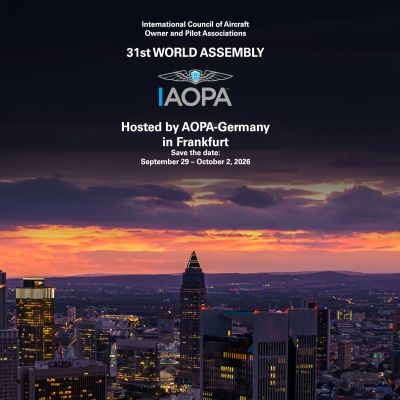
The international General Aviation community will gather in Frankfurt this autumn for the 31st IAOPA World Assembly, taking place from 29 September to 2 October 2026. Hosted by AOPA Germany, the event will bring together AOPA official delegates from around the world for several days of discussion, exchange and cooperation on the key issues shaping the future of General Aviation.
Registration for the World Assembly is now open for the delegates. The programme is still being finalised in cooperation with IAOPA headquarters, but the meeting is expected to feature high-level representatives from aviation authorities, government and industry. Among those confirmed to attend are EASA Executive Director Florian Guillermet and members of his team.
For IAOPA Europe, the gathering will also provide an opportunity to meet at regional level. An abbreviated European Regional Meeting is planned for the afternoon of Tuesday 29 September, from approximately 14:00 to 17:00, ahead of the official opening of the World Assembly. This will allow European affiliates to discuss current regional priorities and coordinate positions before the wider international programme begins.
The combination of the European Regional Meeting and the World Assembly makes Frankfurt an especially important meeting point for IAOPA affiliates in 2026. At a time when General Aviation faces continuing regulatory, operational and political challenges, direct cooperation between national AOPAs — within Europe and globally — remains essential.
The World Assembly will run until Friday 2 October. Participants are reminded that registration for the event and hotel reservations are handled separately. Hotel rooms at the Steigenberger can be booked under the reference “AOPA-Germany” until 28 July 2026.
A strong European turnout will help ensure that the voice of General Aviation is clearly heard in the discussions ahead.
Please keep us informed about the aviation news in your country
If you have any news or things that you would like to share with pilots in other countries - for instance if you organize a Fly-in that might be of interest or if there is news about airports or new rules and regulations in your country that other pilots should know.
Please don't hesitate to send all your news to me:
Gerrit Brand | Netherlands | email: gerritbrand@hotmail.com, telephone or whatsapp + 31 6 50831893
|


_250x167.JPG)